
Introduction
Amsterdam, 12 November 2023. Between 70,000 and 85,000 people march through the city in what organisers call the largest climate protest the Netherlands has ever seen. On stage, Greta Thunberg invites a Palestinian woman and an Afghan woman to speak. A man in a Water Natuurlijk jacket walks onto the stage, grabs her microphone, and says: "I have come here for a climate demonstration, not a political view."
That sentence is the subject of this archive.
Between the 1960s and the 1990s, the Dutch environmental movement produced a rich visual culture — posters against nuclear energy, acid rain, motorways, and pesticides. Solidarity movements created powerful imagery against apartheid in South Africa, and against Shell's complicity in it. But the space between these traditions — where ecology meets colonialism, racism, gender, queer liberation, migration, disability, and labour — remained largely unvisualised. A movement that cannot visualise these connections reproduces the separations it claims to oppose.
In the same decades, often involving the same companies, the Dutch state and Dutch corporations were responsible for large-scale environmental destruction overseas. On Curaçao, Shell ran an oil refinery for sixty-seven years that left behind an estimated 80-hectare toxic asphalt lake. On Bangka and Belitung, Dutch mining companies stripped an estimated 500,000 hectares of forest. On Sumatra, Dutch plantation companies levelled up to 92% of the east coast rainforest. In each of these places, local communities resisted — sometimes for decades. What was absent was not resistance, but solidarity from the Netherlands.
This archive maps twenty-two such cases across two categories. Part 1 documents eleven cases of colonial and corporate environmental destruction where the Dutch environmental movement produced little or no sustained visual solidarity. Part 2 documents eleven unvisualised crossings of ecology with gender, queer liberation, migration, disability, domestic racism, and labour.
The missing images are represented as broken image icons — the familiar cross that appears when a picture fails to load. And the alt-text tells the story that the image would have told, had anyone made it. These are not reconstructions of lost images. They are images that were never made — and that absence is the point.
A note on method: this archive is based on research in the collections of the IISG, Atria, IHLIA, The Black Archives, Laka, the Werker Collective archive, and online sources. The claim of absence is necessarily provisional — archives are incomplete, and local or ephemeral material may exist that this research has not found. Each missing poster is an invitation to look further, not a definitive verdict.
The next phase of this project is to make the missing posters — to produce the activist imagery that was never created. The first, for case 1, is included below.
Sources for introduction: Al Jazeera, NL Times, Euronews (13 Nov 2023); Museum Haven Amsterdam; ANP/Nico Garstman; Laka, IISG; Zembla (BNNVARA, 2013); Curaçao Chronicle; EJAtlas; stichtingsmoc.nl; Stoler (1985); Ross (2017).

alt="A broken image icon — the familiar landscape-with-a-cross that appears when a picture fails to load. The poster that was never made."
What does exist
The Dutch visual tradition this archive measures itself against
The absence documented here is only visible against a tradition that was, in its own domain, remarkably strong. The Dutch environmental and solidarity movements of the 1970s and 1980s produced some of the most powerful activist imagery in Europe. To understand what was never made, we must first look at what was.
The anti-apartheid movement produced a sustained visual campaign against Shell's involvement in South Africa. Posters like "Shell helpt apartheid-terreur in Zuidelijk Afrika," "Shell in Zuidelijk Afrika," and "Olie boycot Zuid-Afrika" were widely distributed and visually sophisticated. They named the company. They named the crime. They called for action. Organisations like the Komitee Zuidelijk Afrika, the Anti-Apartheidsbeweging Nederland, and Werkgroep Kairos sustained this output for over a decade. Designers like Jan Koperdraat and Toos Koedam gave it its recognisable visual language, while Willem van Manen's 1980 Outspan poster confronted Dutch consumers with the violence behind the fruit on their shelves.
The environmental movement, separately, produced its own tradition. "Amsterdam pleegt zelfmoord" campaigned against car pollution. Anti-nuclear posters from Laka's archive document a decade of resistance to Borssele and the Kalkar breeder reactor. Provo's White Plans generated some of the earliest Dutch environmental graphics. Milieudefensie, Greenpeace, and Natuur en Milieu produced campaign material that was visually literate and politically effective.
Internationally, the intersection has been drawn. The Greenham Common Women's Peace Camp combined feminism with anti-nuclear activism. The Chipko movement linked women's labour to forest protection. Ricardo Levins Morales has consistently connected ecology, racism, and labour in poster art. Mothers of East Los Angeles organised against toxic waste from a position of gender, race, and class simultaneously.
In the Netherlands, these traditions ran parallel. The Shell/apartheid posters addressed Shell and racism — but not Shell and ecology. The environmental posters addressed pollution — but not who was most affected, or why. The squatter movement produced radical graphics — but the queer and ecological dimensions of squatting were not drawn together. Each movement had its visual language. What was missing was the poster at the crossing.
Sources: IISG Anti-Apartheid and Southern Africa Collection; Laka Foundation archive; Atria; IHLIA; The Black Archives; Humanity in Action, 'Dutchifying Intersectionality'. International comparisons: Greenham Common documentation; Chipko movement historiography; Ricardo Levins Morales Art Studio (rlmartstudio.com).
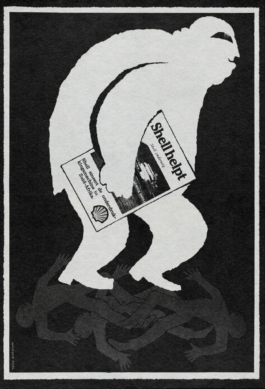
"Shell helpt, Shell onderweg." Designer: Toos Koedam. Komitee Zuidelijk Afrika / Werkgroep Kairos, 1979. A white figure tramples Black bodies while clutching a Shell advertisement. Collection: IISG (CSD BG D70/99).
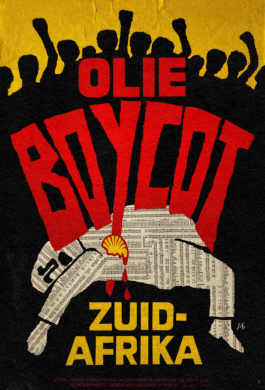
"Olie boycot Zuid-Afrika." Designer: Jan Koperdraat. Komitee Zuidelijk Afrika, 1979. Raised fists in silhouette, Shell logo dripping blood onto a map of South Africa made of newspaper text. Collection: IISG (CSD BG D70/89).
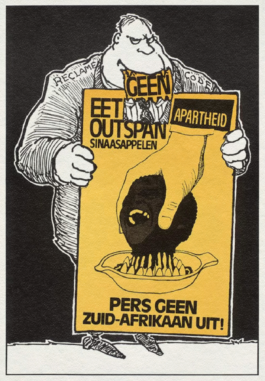
"Pers geen Zuid-Afrikaan uit." Designer: Willem van Manen. Boycot Outspan Aktie, 1980. A white figure holds up an advertisement showing a Black person squeezed like an orange. Collection: IISG (BG D11/285).
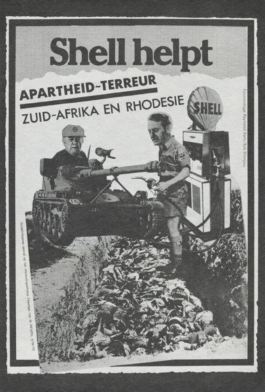
"Shell helpt apartheid-terreur — Zuid-Afrika en Rhodesië." Designers: Raymond Aerts & Rob Blomjous. 1979. Photomontage: a Shell petrol pump fuelling a military vehicle driving over bodies. Collection: IISG (CSD BG D70/100).
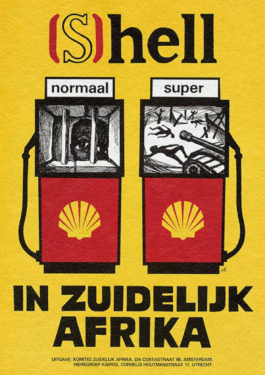
""Shell in Zuidelijk Afrika" (stylised as "(S)hell"). Designer: Jan Koperdraat. Komitee Zuidelijk Afrika / Werkgroep Kairos, 1978. Two Shell pumps dispensing "normaal" and "super" — behind the nozzles: imprisonment and violence. Collection: IISG (CSD BG D70/103).
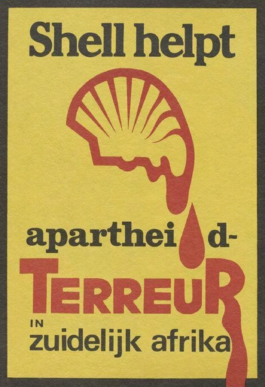
"Shell helpt apartheid-terreur in Zuidelijk Afrika." Designer: Toos Koedam. Komitee Zuidelijk Afrika / Werkgroep Kairos, 1979. The Shell logo melts into drops of blood. Collection: IISG (CSD BG D70/98).
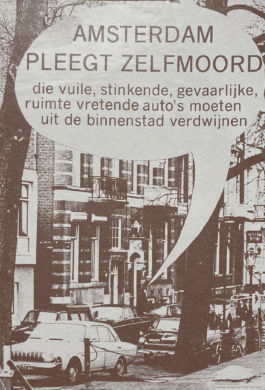
"Amsterdam pleegt zelfmoord." Design: Hans Sijses. Realisation: Anneke van Steijn / Hans Sijses. c. 1970s. Speech bubble over a congested Amsterdam street. The Dutch environmental movement at its most direct — but addressing pollution as a local, urban, white concern. No connection drawn to ecology elsewhere.
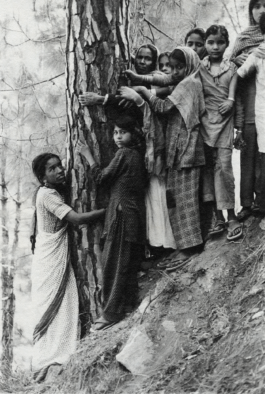
Chipko movement, India (1973–present). Women-led forest conservation through tree-hugging. Folk songs rather than printed posters, but the imagery — women embracing trees — became one of the most recognised symbols of ecofeminist resistance worldwide.
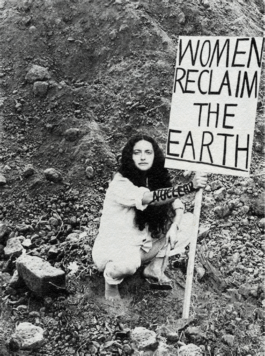
"Women Reclaim the Earth." Leslie Labowitz-Starus. Performance photograph / poster, 1979. Labowitz-Starus had spent the late 1970s making feminist performances about violence against women with Suzanne Lacy. This poster marked her pivot toward ecofeminism. Three words. Feminism and ecology fused before the word ecofeminism was widely used. Re-exhibited in "Life on Earth: Art & Ecofeminism," The Brick, Los Angeles (2024), Getty PST ART initiative — in collaboration with West Den Haag. Source: leslielabowitz.com.
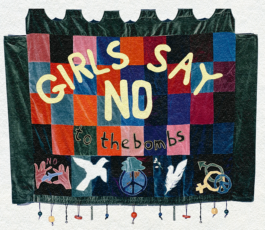
"Girls Say No to the Bombs." Thalia Campbell. Patchwork banner, velvet and appliqué, early 1980s. Made for Greenham Common Women's Peace Camp. Doves, peace sign, lily of the valley, interlocking gender symbols. The tactile objects at the bottom were sewn on for children at Red Gate. Collection: The Peace Museum, Bradford. Published in Charlotte Dew, Women For Peace: Banners from Greenham Common (Four Corners Books, 2021).
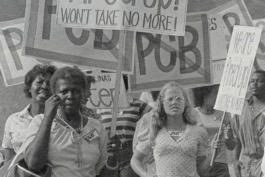
Warren County, North Carolina, September 1982. Photographs: Jenny Labalme / Jerome Friar Collection, UNC Libraries. North Carolina selected a majority-Black community to store 60,000 tonnes of PCB-contaminated soil. Over 500 arrested. Ben Chavis named it "environmental racism" — the first recorded use of the term. Widely considered the origin of the environmental justice movement. Source: aroadtowalk.com; UNC Libraries.
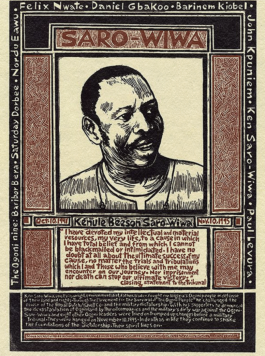
"Saro-Wiwa." Ricardo Levins Morales Art Studio. Portrait poster with text from his closing statement at the military tribunal, 1995. Saro-Wiwa led MOSOP against Shell's devastation of Ogoniland — where an estimated 40% of mangrove forests have been destroyed (UNEP, 2011). Executed 10 November 1995. The same Shell that Dutch activists drew dripping blood over South Africa. The poster for Shell dripping oil over the Niger Delta was made — but not in the Netherlands. Source: rlmartstudio.com.
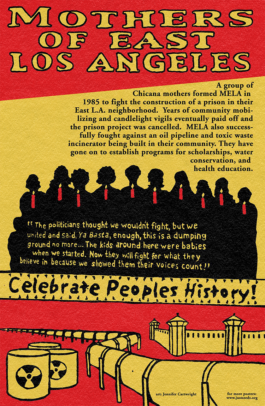
"Mothers of East Los Angeles." Celebrate People's History poster. Art: Jennifer Cartwright. Printed at Stumptown Printers, Portland, OR. c. 2001–2005. In 1985, Chicana mothers organised against a prison, a toxic waste incinerator, and an oil pipeline. Gender, race, class, and ecology combined from the start — not as theory, but as the daily practice of protecting their families. Source: justseeds.org.
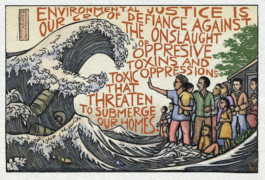
Ricardo Levins Morales — "Environmental Justice." Northland Poster Collective, 2010. Ecology, racism, and labour united in a single image. The wave of pollution meets the community that resists it. Source: rlmartstudio.com.
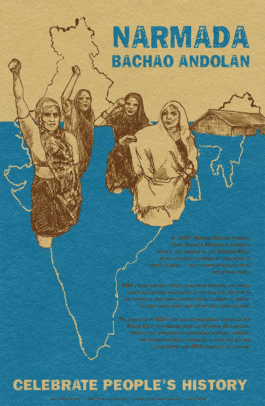
"Narmada Bachao Andolan." Celebrate People's History poster series, Justseeds. In 1989, adivasi communities, farmers, women, and environmentalists formed the Save Narmada Movement against large dams displacing hundreds of thousands. Ecology, caste, gender, and displacement combined. The World Bank withdrew under pressure. Source: justseeds.org.
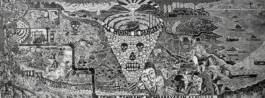
"All Mining is Dangerous." Taring Padi collective, Yogyakarta. Woodcut on fabric, 108 x 495 cm, 2010. Founded 1998 after the fall of Suharto. Woodcuts, banners, and wayang puppets address anti-militarism, environmental destruction, gender justice, LGBTQIA+ rights, labour exploitation, and colonial continuity as one interwoven struggle. Exhibited at Framer Framed, Amsterdam, 2023 ("Tanah Merdeka"). Indonesia is not an arbitrary example: the Deli plantations, the Billiton tin mines, the BPM oil fields — the cases from Part I took place on the same ground Taring Padi comes from. Source: taringpadi.com; framerframed.nl.
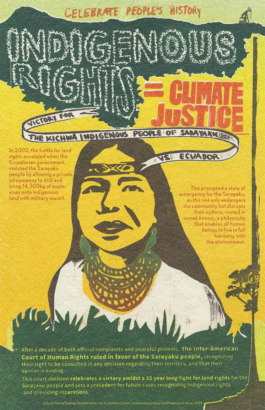
"Indigenous Rights = Climate Justice." Celebrate People's History poster #193, Justseeds. Printed at Community Printers, Santa Cruz, CA. The Sarayaku people of Ecuador fought twenty-two years against oil extraction. In 2012, the Inter-American Court of Human Rights ruled in their favour. Indigenous rights, ecology, colonial extraction, and legal struggle in a single case — and a single poster. Source: justseeds.org.
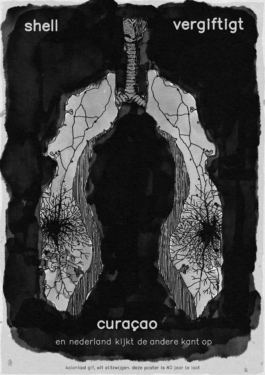
"Shell vergiftigt Curaçao — en Nederland kijkt de andere kant op." Ester Venema / Dreaming Problems, 2026. Lungs in the shape of Curaçao, blackened by sixty-seven years of refinery emissions. This is the first image produced in response to that absence. This poster is forty years too late.
1. The asphalt lake of Curaçao — Shell’s Isla refinery
In 1918, Royal Dutch Shell opened an oil refinery on Curaçao, part of the Dutch Kingdom. For sixty-seven years, it processed Venezuelan crude oil. It created a toxic asphalt lake in the Buscabaai, estimated at 80 hectares. In 1985, Shell sold the refinery for a symbolic sum with a contractual clause waiving all liability. According to a study commissioned by ECORYS, an estimated eighteen people die prematurely each year from the refinery's emissions. The approximately 20,000 people living under the smoke are disproportionately among the poorest residents.
On Curaçao itself, citizens have fought for decades. The uprising of Trinta di Mei in 1969 began as a strike at the Shell refinery. Stichting SMOC, Amigu di Tera, and the Humanitaire Zorg foundation have waged legal battles and organised demonstrations since the early 2000s. In 2016, residents marched along schools in white overalls and gas masks.
No sustained campaign from the Dutch environmental movement — nothing comparable to the dozens of anti-apartheid posters — has been found. Shell was a Dutch company. Curaçao was part of the Dutch Kingdom. The absence is not a gap in Curaçaoan resistance — it is a failure of Dutch solidarity.
This case can also be read as structural racism within the Kingdom. The approximately 20,000 people living under the smoke are predominantly low-income and non-white. A legal study from VU Amsterdam has argued the Kingdom may violate the ECHR. It is difficult to imagine an equivalent scenario in metropolitan Netherlands.
Sources: Zembla (BNNVARA), 'Stikken in het paradijs' (2013); Curaçao Chronicle (2013); Al Jazeera (2019); ECORYS study; EJAtlas; Snijders, VU Amsterdam (2018); stichtingsmoc.nl; Friends of the Earth / Milieudefensie.

alt="BPM/Shell, Borneo and Sumatra. Between 85% and 95% of oil in the Dutch East Indies. 700 wells on Tarakan. The profits built The Hague. This poster was never made."
2. BPM/Shell — Colonial oil extraction in Borneo and Sumatra
The Bataafsche Petroleum Maatschappij, Shell's colonial subsidiary, dominated the Indonesian oil industry — producing, by some accounts, between 85% and 95% of crude oil in the Dutch East Indies during the 1920s and 1930s. On Tarakan, BPM drilled some 700 oil wells. The profits helped build The Hague. The environmental cost stayed behind.
After independence, Indonesia nationalised the oil fields. The colonial oil industry has largely faded from Dutch public memory — often remembered as entrepreneurial success, not ecological debt. No sustained Dutch environmental campaign has addressed this legacy.
Sources: Lindblad, 'The Petroleum Industry in Indonesia before the Second World War,' Bulletin of Indonesian Economic Studies 25:2 (1989); De Vries, 'Petroleumscape as Battleground,' in Petroleumscapes (Routledge, 2021); Ross, Ecology and Power in the Age of Empire (OUP, 2017).

alt="Billiton, Bangka and Belitung. 500,000 hectares cleared. Over 12,000 toxic pits. The Dead Islands. This poster was never made."
3. Billiton tin mining — The “Dead Islands” of Bangka and Belitung
In 1860, Dutch investors founded the Billiton Maatschappij. Environmental studies estimate that some 500,000 hectares of forest were cleared. Over 12,000 unreclaimed mining pits remain. The company became BHP Billiton.
Today, WALHI Bangka Belitung campaigns against ongoing tin mining. Local communities protest illegal operations. From the Netherlands — whose investors started it — no sustained response.
Sources: Erman, Miners, Managers and the State; WALHI Bangka Belitung (2023); Nurtjahya et al., 'The Impact of Tin Mining in Bangka Belitung,' MATEC Web of Conferences (2017); The Gecko Project, 'The Tin Racket' (2025).
4. Ombilin coal mine — Chain gang labourers in West Sumatra
In 1891, the Dutch colonial government opened a coal mine using orang rantai — chain gang labourers, documented in colonial sources and acknowledged by UNESCO as “convict labourers.” In 2019, UNESCO designated it a World Heritage Site. The forced labourers are mentioned once, in passing.
Criticism of the UNESCO nomination came from Indonesian academics. In the Netherlands, this history remains unaddressed in activist visual culture.
Sources: UNESCO World Heritage nomination dossier (2019); Erman; Inside Indonesia.

alt="Ombilin coal mine. Chain gang labourers. UNESCO World Heritage Site. The chains are not on the certificate. This poster was never made."

alt="Deli plantation belt, Sumatra. Over 200 plantations. Up to 92% of the rainforest cleared. This poster was never made."
5. The Deli plantation belt — Tobacco, rubber, and deforestation
In 1863, the east coast of Sumatra was mostly rainforest. By 1940, historical estimates suggest up to 92% was gone. Over 200 plantations operated on hundreds of thousands of hectares. Labour was regulated by the Coolie Ordinance: contract bondage with penal sanctions.
Sumatranese workers resisted through desertion and sabotage. Today, Greenpeace campaigns against palm oil plantations that stand on the same ground — though Greenpeace frames this as corporate failure, not colonial continuity. That poster has not been made.
Sources: Stoler, Capitalism and Confrontation (Yale, 1985); Breman, Taming the Coolie Beast (OUP, 1989); Ross (2017).

alt="Margarine Unie and palm oil. Congo 1911, Unilever 1929. 24 million hectares lost. This poster was never made."
6. Unilever / Margarine Unie — Palm oil from Congo to Borneo
In 1911, William Lever established palm oil concessions in the Belgian Congo. In 1929, Lever Brothers merged with the Dutch Margarine Unie. Between 1990 and 2015, Indonesia lost an estimated 24 million hectares of rainforest (official Indonesian government figures). The fires of 2015 were linked to an estimated 100,000 premature deaths according to a model-based study by Koplitz et al. (2016).
Indigenous communities in Kalimantan and Sulawesi have fought land seizures for decades. Greenpeace has run extensive campaigns on Indonesian palm oil since 2008, including the occupation of a Unilever factory in Rotterdam. However, this campaign material tends to frame the problem as contemporary corporate failure, not as colonial continuity.
Sources: Jones, Renewing Unilever (OUP, 2005); Koplitz et al., Environmental Research Letters 11 (2016); Greenpeace International; Milieudefensie/FoE.

alt="Groningen and Shell's colonial operations. One company: BPM, Isla, Ogoni, NAM. Over 1,500 recorded earthquakes. This poster was never made."
7. NAM / Gas extraction in Groningen — A domestic mirror
The NAM extracted gas for sixty-five years. Over 1,500 recorded earthquakes (KNMI data). An estimated 20,000 residents with stress-related health complaints (parliamentary inquiry, 2023). The inquiry concluded the government systematically prioritised revenue over safety.
The Groninger Bodem Beweging, fakkeltochten, and community organisations fought for decades and achieved concrete results: the parliamentary inquiry and the closure of the gas field. Groningen is not a colonial case. It is a domestic mirror that shows how certain patterns of centre-periphery extraction persist.
Sources: Parlementaire enquêtecommissie aardgaswinning Groningen (2023); Groninger Bodem Beweging; KNMI; RUG.

alt="Banned pesticide exports through Rotterdam. Close to 15,000 tonnes. The flowers come back to Aalsmeer. This poster was never made."
8. Dutch pesticide exports — Poison to the Global South
Dutch companies export thousands of tonnes of EU-banned pesticides annually through Rotterdam. According to investigations by Unearthed and Public Eye, in 2022 six Dutch companies planned to export close to 15,000 tonnes. In South Africa, women on vineyards and flower farms handle these pesticides, often with inadequate protection.
Women on Farms Project (South Africa) and PAN-NL campaign against this trade. The poster tracing the colonial route — from Rotterdam harbour to the vineyard and back to the Aalsmeer auction — has not been made.
Sources: Unearthed/Public Eye (2020–2022); PAN Europe/PAN-NL (2023); UN Special Rapporteur on toxics.
alt="Bauxite mining near Moengo, Suriname. Red craters. Maroon communities. Alcoa left. The red mud stayed. This poster was never made."
9. Suralco/Alcoa — Bauxite mining in Suriname
In 1916, Suralco began mining near Moengo. The town became segregated. When the bauxite ran out, the town's infrastructure collapsed. Maroon communities were disproportionately affected; their land rights were never formally recognised. Maroon communities fought for land rights at the Inter-American Court of Human Rights (Saramaka v. Suriname, 2007). The Kibii Foundation in Moengo addresses the mining legacy through art. Dutch solidarity, in visual form, has not materialised.
Sources: Hoefte (Palgrave, 2014); Price (Penn, 2011); Kibii Foundation; Saramaka v. Suriname (IACtHR, 2007).
10. Rubber plantations — Permanent ecological transformation
Around 1906, Dutch companies switched to rubber. Goodyear acquired some 20,000 acres through Dutch colonial concessions, reportedly building the largest rubber plantation in the world. Rubber plantations are permanent monocultures.
After rubber came palm oil. The plantation infrastructure was recycled for each new crop.
Sources: Stoler (1985); Ross (2017); Breman (1989).
alt="Rubber plantations on Sumatra. Permanent monoculture. The same soil now grows palm oil. This poster was never made."

alt="The Probo Koala. Amsterdam to Abidjan. Over 100,000 sought medical help. This poster was never made."
11. Probo Koala / Trafigura — Toxic waste from Amsterdam to Abidjan
In August 2006, over 500 cubic metres of toxic waste were dumped at eighteen sites in Abidjan. The waste had first been brought to Amsterdam. According to Amnesty International and official Ivorian government reports, over 100,000 people sought medical help. Seventeen died according to government figures. Trafigura paid settlements but never admitted liability.
In Abidjan, there was broad public protest. Local workers from poorer regions reportedly handled the waste without adequate protection. The poison began on the Amsterdam quayside.
Sources: Amnesty International, A Toxic Truth (2012); The Guardian (2009); BBC.


alt="PFOA in breast milk, Dordrecht. Up to 13,000 times above the guideline at specific points. They said nothing. This poster was never made."
12. PFOA in breast milk — Dordrecht, 1967–present
Environment + gender
DuPont produced PFOA in Dordrecht from 1967. Elevated concentrations have been measured in the breast milk of local women. Internal documents suggest DuPont knew since the 1990s. At specific measurement points in ditches approximately one kilometre from the factory, PFOA concentrations have been recorded at up to 13,000 times above the RIVM safety guideline. These measurements reflect localised contamination and should not be generalised to the wider region.
In 2023, some 3,000 residents filed a collective criminal complaint via strafrechtadvocaat Bénédicte Ficq. Stichting Het Wantij conducts WOB requests. The poster depicting breast milk as toxic substance — not nourishment — has not been found.
Sources: RIVM blood study (2017); RIVM national PFAS study (2025); Zembla (2022–); GGD ZHZ; Gemeente Dordrecht.
alt="Women and the Groningen earthquakes. Women report more stress. They make the phone calls. The gas revenue went to The Hague. This poster was never made."
13. Groningen — Women and the care burden of the earthquakes
Environment + gender
Research from the University of Groningen indicates that women in the earthquake zone report significantly more stress, anxiety, and depression than men. They disproportionately bear the burden of damage claims.
Women in the earthquake area are active in community organisations. Gas extraction as a gender story — that poster remains unmade.
Sources: Postmes et al., Gronings Perspectief (RUG/CMO, 2018–); Parlementaire enquêtecommissie (2023); Groninger Bodem Beweging.

alt="Shell sponsoring Pride while linked to Ogoniland destruction. Rainbow logo in Amsterdam. Up to fourteen years in prison in Nigeria. This poster was never made."
14. Shell and Pride Amsterdam — 2004–2023
Environment + queer
Shell sponsored Pride Amsterdam from 2004 to 2023. In the same period, Shell was linked to large-scale environmental damage in the Niger Delta, where according to a 2011 UNEP assessment some 40% of mangrove forests have been destroyed. In Nigeria, homosexuality is punishable by up to fourteen years under the Criminal Code Act.
MOSOP and Ken Saro-Wiwa's resistance is well documented. In the Netherlands, criticism of Shell's pinkwashing grew over the years. The poster that places the Shell logo in rainbow colours above Ogoniland has not been made.
Sources: Pride Amsterdam archives; UNEP, Environmental Assessment of Ogoniland (2011); Nigeria Criminal Code Act, Section 214.
15. The squatter movement — Queer and green, separated
Environment + queer
The Amsterdam squatter movement of the 1980s was both a queer haven and an ecological experiment. In practice, these worlds overlapped — many of the same people organised queer spaces and experimented with ecological living. But in the archived visual language of the movement, these dimensions were not explicitly connected. Today, it is precisely in queer communities that some of the most explicit connections between ecology, identity, and justice are being made — an intersectional practice that has been a direct inspiration for this research. That makes the historical absence all the more visible.
It is possible that such connections existed in zines, flyers, or ephemeral material that was never archived.
Sources: Duivenvoorden, Een voet tussen de deur (2000); IHLIA archive; Laka archive.

alt="Queer and green in the squatter movement. Connected in practice. Not found in the poster archive. This poster was never made."

alt="Migrant workers in Westland greenhouses. Up to 17,000 workers. Over 40 pesticides detected. This poster was never made."
16. The greenhouses of Westland — Migrant workers and pesticides
Environment + migration
In the Westland, an estimated 12,000 to 17,000 migrant workers from Poland, Bulgaria, and Romania work in greenhouses. In 2024, according to monitoring by the Hoogheemraadschap van Delfland, more than forty pesticides were detected in ditch water, including banned substances. Long-term residents report elevated Parkinson's rates; the potential causal link between pesticide exposure and Parkinson's disease is under active scientific investigation but has not been conclusively established for this specific region.
Migrant workers are largely invisible in health statistics. The RIVM describes this type of work as "DDD: dirty, dangerous, demeaning." Vereniging Natuurlijk Westland campaigns locally; FNV advocates for migrant worker rights. The poster for the worker inhaling pesticides so Dutch supermarkets can sell tomatoes year-round has not been made.
Sources: PAN Europe/PAN-NL (2023); Hoogheemraadschap Delfland (2024); Omroep West (2026); NOS/Nieuwsuur (2024); TBV-Online (2026).

alt="The waste handlers of Abidjan. The poison began in Amsterdam. The hands that touched it were unprotected. This poster was never made."
17. The hands that touched it — Abidjan, 2006
Environment + migration
When the toxic waste was dumped in Abidjan, it was reportedly local workers from poorer regions who emptied the containers without adequate protection. The contractor was hired for a fraction of the Amsterdam price.
The poison began on the Amsterdam quayside; the hands that ultimately touched it were unprotected and underpaid.
Sources: Amnesty International, A Toxic Truth (2012). See also case 11.

alt="Gas extraction and mental health. 20,000 with stress-related complaints. This poster was never made."
18. Groningen — Stress-related illness from gas extraction
Environment + disability
The parliamentary inquiry of 2023 documented that gas extraction has been associated with an estimated 20,000 people experiencing stress-related health complaints: PTSD, anxiety, sleep problems, depression. Children in the earthquake zone scored significantly higher on anxiety measures in university research.
This is disability caused by environmental damage — but rarely framed as such. The poster that says "gas extraction gave me an anxiety disorder" has not been made.
Sources: Parlementaire enquêtecommissie (2023); RUG child health research; GGD Groningen.
19. IJmuiden — Lung disease in the shadow of Tata Steel
Environment + disability
In the IJmond region, rates of lung cancer and respiratory disease have been documented as significantly above the national average. The RIVM confirmed in 2021 that residents near Tata Steel face elevated health risks. People with existing COPD or asthma are the most vulnerable.
Residents of Wijk aan Zee and surrounding areas have been active for years through Frisse Wind and local councils. The poster that frames air pollution near Tata as a disability issue has not been made.
Sources: RIVM, Gezondheidsonderzoek IJmond (2021/2022); Dorpsraad Wijk aan Zee; Milieudefensie.

alt="Lung disease near Tata Steel. Elevated lung cancer rates documented by RIVM. Cannot go outside when the wind is wrong. This poster was never made."

alt="Air quality and postcode in Rotterdam. Documented correlations between postcode, migration background, and air quality. This poster was never made."
20. Fine particulate matter and postcode — Who lives where in Rotterdam
Environment + domestic racism
In Rotterdam-Zuid, a disproportionate share of residents have a migration background. RIVM monitoring data indicates higher concentrations of fine particulate matter and nitrogen dioxide in these areas compared to more affluent parts of the city.
The interpretation of these correlations as "environmental racism" is an analytical frame drawn from the environmental justice tradition. It is rarely applied in the Dutch context, and has not been visually depicted as activist material in the archives consulted.
Sources: RIVM air quality monitoring; GGD Rotterdam-Rijnmond; DCMR Milieudienst Rijnmond.

alt="Asbestos in Goor. Eternit, sixty years. The women who washed the overalls developed mesothelioma. This poster was never made."
21. Asbestos in Goor — Eternit, 1937–1997
Environment + labour
In Goor, the Eternit factory produced asbestos cement for sixty years. Fibres spread to surrounding working-class neighbourhoods. Employees carried dust home on their clothes; their partners and children were exposed. Goor has one of the highest documented mesothelioma rates in the Netherlands.
Asbestos victims and their families fought for compensation for years; the Instituut Asbestslachtoffers was established as a direct result. Trade unions campaigned for compensation, but no poster framed this as an environmental issue. The poster connecting the factory to the lungs of the women who washed the overalls has not been made.
Sources: Instituut Asbestslachtoffers (IAS); FNV; Stichting Asbestslachtoffers; local media Hof van Twente.

alt="PFAS in Dordrecht. Up to 13,000 times above the guideline at specific points. 3,000 filed criminal complaints. Nobody told you. This poster was never made."
22. Chemours Dordrecht — PFAS in the blood, 1967–present
Environment + labour
DuPont/Chemours has produced PFAS in Dordrecht since 1967. According to investigative reporting by Zembla, the company was aware for approximately thirty years that groundwater was contaminated. RIVM measurements in 2017 found PFOA in the blood of 382 residents; concentrations correlated with proximity to the factory.
In 2023, some 3,000 residents filed a collective criminal complaint. The factory is in an area with a relatively high proportion of social housing — the residents exposed longest tend to be those who moved least: people who could not afford to leave. The poster that says "your neighbours have been poisoned for fifty years and nobody told you" has not been made.
Sources: RIVM (2017, 2025); Zembla (2022–); OM; Provincie ZH; GGD ZHZ; Stichting Het Wantij.


alt="A broken image icon — the familiar landscape-with-a-cross that appears when a picture fails to load. The poster that was never made."
"Shell helpt, Shell onderweg." Designer: Toos Koedam. Komitee Zuidelijk Afrika / Werkgroep Kairos, 1979. A white figure tramples Black bodies while clutching a Shell advertisement. Collection: IISG (CSD BG D70/99).
"Olie boycot Zuid-Afrika." Designer: Jan Koperdraat. Komitee Zuidelijk Afrika, 1979. Raised fists in silhouette, Shell logo dripping blood onto a map of South Africa made of newspaper text. Collection: IISG (CSD BG D70/89).
"Pers geen Zuid-Afrikaan uit." Designer: Willem van Manen. Boycot Outspan Aktie, 1980. A white figure holds up an advertisement showing a Black person squeezed like an orange. Collection: IISG (BG D11/285).
""Shell helpt apartheid-terreur — Zuid-Afrika en Rhodesië." Designers: Raymond Aerts & Rob Blomjous. 1979. Photomontage: a Shell petrol pump fuelling a military vehicle driving over bodies. Collection: IISG (CSD BG D70/100).
"Shell helpt apartheid-terreur in Zuidelijk Afrika." Designer: Toos Koedam. Komitee Zuidelijk Afrika / Werkgroep Kairos, 1979. The Shell logo melts into drops of blood. Collection: IISG (CSD BG D70/98).
"Amsterdam pleegt zelfmoord." Design: Hans Sijses. Realisation: Anneke van Steijn / Hans Sijses. c. 1970s. Speech bubble over a congested Amsterdam street. The Dutch environmental movement at its most direct — but addressing pollution as a local, urban, white concern. No connection drawn to ecology elsewhere.
"Shell in Zuidelijk Afrika" (stylised as "(S)hell"). Designer: Jan Koperdraat. Komitee Zuidelijk Afrika / Werkgroep Kairos, 1978. Two Shell pumps dispensing "normaal" and "super" — behind the nozzles: imprisonment and violence. Collection: IISG (CSD BG D70/103).
Chipko movement, India (1973–present). Women-led forest conservation through tree-hugging. Folk songs rather than printed posters, but the imagery — women embracing trees — became one of the most recognised symbols of ecofeminist resistance worldwide.
"Women Reclaim the Earth." Leslie Labowitz-Starus. Performance photograph / poster, 1979. Labowitz-Starus had spent the late 1970s making feminist performances about violence against women with Suzanne Lacy. This poster marked her pivot toward ecofeminism. Three words. Feminism and ecology fused before the word ecofeminism was widely used. Re-exhibited in "Life on Earth: Art & Ecofeminism," The Brick, Los Angeles (2024), Getty PST ART initiative — in collaboration with West Den Haag. Source: leslielabowitz.com.
"Girls Say No to the Bombs." Thalia Campbell. Patchwork banner, velvet and appliqué, early 1980s. Made for Greenham Common Women's Peace Camp. Doves, peace sign, lily of the valley, interlocking gender symbols. The tactile objects at the bottom were sewn on for children at Red Gate. Collection: The Peace Museum, Bradford. Published in Charlotte Dew, Women For Peace: Banners from Greenham Common (Four Corners Books, 2021).
Warren County, North Carolina, September 1982. Photographs: Jenny Labalme / Jerome Friar Collection, UNC Libraries. North Carolina selected a majority-Black community to store 60,000 tonnes of PCB-contaminated soil. Over 500 arrested. Ben Chavis named it "environmental racism" — the first recorded use of the term. Widely considered the origin of the environmental justice movement. Source: aroadtowalk.com; UNC Libraries.
"Saro-Wiwa." Ricardo Levins Morales Art Studio. Portrait poster with text from his closing statement at the military tribunal, 1995. Saro-Wiwa led MOSOP against Shell's devastation of Ogoniland — where an estimated 40% of mangrove forests have been destroyed (UNEP, 2011). Executed 10 November 1995. The same Shell that Dutch activists drew dripping blood over South Africa. The poster for Shell dripping oil over the Niger Delta was made — but not in the Netherlands. Source: rlmartstudio.com.
"Mothers of East Los Angeles." Celebrate People's History poster. Art: Jennifer Cartwright. Printed at Stumptown Printers, Portland, OR. c. 2001–2005. In 1985, Chicana mothers organised against a prison, a toxic waste incinerator, and an oil pipeline. Gender, race, class, and ecology combined from the start — not as theory, but as the daily practice of protecting their families. Source: justseeds.org.
Ricardo Levins Morales — "Environmental Justice." Northland Poster Collective, 2010. Ecology, racism, and labour united in a single image. The wave of pollution meets the community that resists it. Source: rlmartstudio.com.
"Narmada Bachao Andolan." Celebrate People's History poster series, Justseeds. In 1989, adivasi communities, farmers, women, and environmentalists formed the Save Narmada Movement against large dams displacing hundreds of thousands. Ecology, caste, gender, and displacement combined. The World Bank withdrew under pressure. Source: justseeds.org.
"All Mining is Dangerous." Taring Padi collective, Yogyakarta. Woodcut on fabric, 108 x 495 cm, 2010. Founded 1998 after the fall of Suharto. Woodcuts, banners, and wayang puppets address anti-militarism, environmental destruction, gender justice, LGBTQIA+ rights, labour exploitation, and colonial continuity as one interwoven struggle. Exhibited at Framer Framed, Amsterdam, 2023 ("Tanah Merdeka"). Indonesia is not an arbitrary example: the Deli plantations, the Billiton tin mines, the BPM oil fields — the cases from Part I took place on the same ground Taring Padi comes from. Source: taringpadi.com; framerframed.nl.
"Indigenous Rights = Climate Justice." Celebrate People's History poster #193, Justseeds. Printed at Community Printers, Santa Cruz, CA. The Sarayaku people of Ecuador fought twenty-two years against oil extraction. In 2012, the Inter-American Court of Human Rights ruled in their favour. Indigenous rights, ecology, colonial extraction, and legal struggle in a single case — and a single poster. Source: justseeds.org.
"Shell vergiftigt Curaçao — en Nederland kijkt de andere kant op." Ester Venema / Dreaming Problems, 2026. Lungs in the shape of Curaçao, blackened by sixty-seven years of refinery emissions. This is the first image produced in response to that absence. This poster is forty years too late.
alt="BPM/Shell, Borneo and Sumatra. Between 85% and 95% of oil in the Dutch East Indies. 700 wells on Tarakan. The profits built The Hague. This poster was never made."
alt="Billiton, Bangka and Belitung. 500,000 hectares cleared. Over 12,000 toxic pits. The Dead Islands. This poster was never made."
alt="Ombilin coal mine. Chain gang labourers. UNESCO World Heritage Site. The chains are not on the certificate. This poster was never made."
alt="Deli plantation belt, Sumatra. Over 200 plantations. Up to 92% of the rainforest cleared. This poster was never made."
alt="Margarine Unie and palm oil. Congo 1911, Unilever 1929. 24 million hectares lost. This poster was never made."
alt="Groningen and Shell's colonial operations. One company: BPM, Isla, Ogoni, NAM. Over 1,500 recorded earthquakes. This poster was never made."
alt="Banned pesticide exports through Rotterdam. Close to 15,000 tonnes. The flowers come back to Aalsmeer. This poster was never made."
alt="Bauxite mining near Moengo, Suriname. Red craters. Maroon communities. Alcoa left. The red mud stayed. This poster was never made."
alt="Rubber plantations on Sumatra. Permanent monoculture. The same soil now grows palm oil. This poster was never made."
alt="The Probo Koala. Amsterdam to Abidjan. Over 100,000 sought medical help. This poster was never made."
alt="PFOA in breast milk, Dordrecht. Up to 13,000 times above the guideline at specific points. They said nothing. This poster was never made."
alt="Women and the Groningen earthquakes. Women report more stress. They make the phone calls. The gas revenue went to The Hague. This poster was never made."
alt="Shell sponsoring Pride while linked to Ogoniland destruction. Rainbow logo in Amsterdam. Up to fourteen years in prison in Nigeria. This poster was never made."
alt="Queer and green in the squatter movement. Connected in practice. Not found in the poster archive. This poster was never made."
alt="Migrant workers in Westland greenhouses. Up to 17,000 workers. Over 40 pesticides detected. This poster was never made."
alt="The waste handlers of Abidjan. The poison began in Amsterdam. The hands that touched it were unprotected. This poster was never made."
alt="Gas extraction and mental health. 20,000 with stress-related complaints. This poster was never made."
alt="Lung disease near Tata Steel. Elevated lung cancer rates documented by RIVM. Cannot go outside when the wind is wrong. This poster was never made."
alt="Air quality and postcode in Rotterdam. Documented correlations between postcode, migration background, and air quality. This poster was never made."
alt="Asbestos in Goor. Eternit, sixty years. The women who washed the overalls developed mesothelioma. This poster was never made."
alt="PFAS in Dordrecht. Up to 13,000 times above the guideline at specific points. 3,000 filed criminal complaints. Nobody told you. This poster was never made."